Choosing the Right Light Diffuser for Your Lighting Application
Finding the right balance of light transmission, diffusion and appearance
Selecting a light diffuser involves more than choosing a material that softens light. The diffuser influences light transmission, illumination uniformity, color appearance and the overall look of a lighting fixture.
ACRYLITE® acrylic products offer a range of solutions to help lighting manufacturers and designers achieve their desired lighting effects. The right material depends on the fixture’s appearance, lighting performance requirements and illumination method.
Three considerations can help guide your selection.
What appearance do you want to achieve?
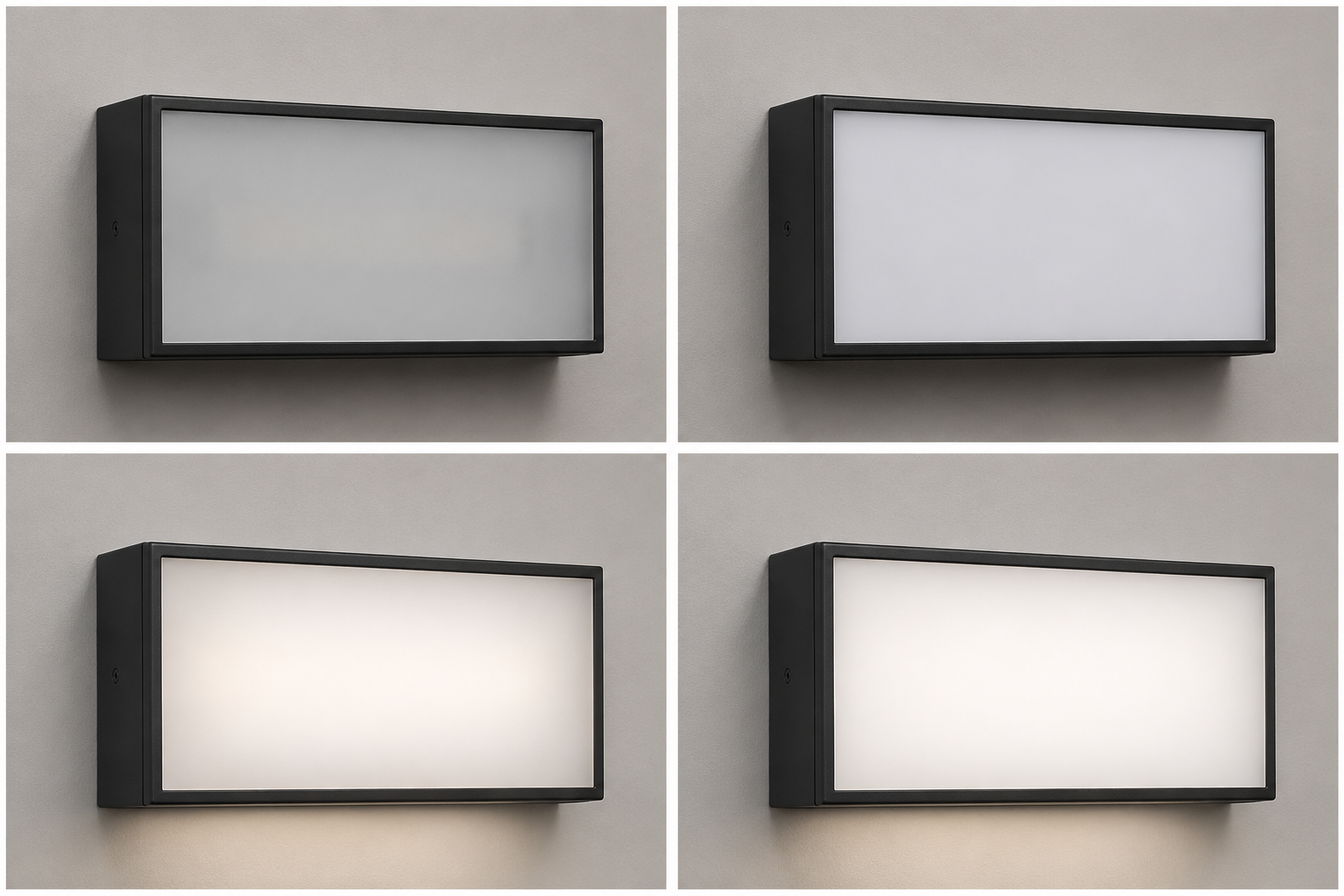
The appearance of a diffuser is an important consideration, both when the fixture is illuminated and when it is switched off. Color, surface finish and light transmission all contribute to the final appearance.
Colorless or white diffusion?
Colorless diffusion
ACRYLITE® Satinice optimum light diffusion 0D010 DF combines high light transmission with effective diffusion. Its colorless appearance is well suited to fixtures where maximizing light transmission is a priority. When the fixture is switched off, it offers a more neutral appearance than a white diffuser.
White diffusion
ACRYLITE® Satinice optimum light diffusion WD008 DF provides a distinctly white appearance, making it a good choice for fixture designs where the diffuser remains visible when the lighting is switched off. It offers a different balance of appearance and light transmission.
Consider the surface finish
A frosted surface can contribute to a refined, consistent appearance in lighting fixtures. ACRYLITE® Satinice products feature frosted surfaces in a variety of finishes and textures, providing additional design flexibility.
Because the final appearance depends on the complete fixture design, evaluate material samples and build a prototype, particularly when several stakeholders are involved in approval.
What lighting performance do you need?
The balance between light transmission and diffusion is central to diffuser selection. The right combination depends on the fixture’s efficiency targets, desired illumination and optical design.
Light transmission and power efficiency
For lighting fixtures targeting high lumens-per-watt (lm/W) specifications, maximizing light transmission is an important consideration. ACRYLITE® Satinice optimum light diffusion enhanced offers high transmission across a range of diffusion levels, helping lighting manufacturers meet their light output and efficiency objectives.
Selecting the right diffusion level
The enhanced family offers four grades with different combinations of light transmission and diffusion.
| Grade | Relative diffusion | Relative transmission | Light transmission | Half angle |
|---|---|---|---|---|
| WD852 | Lowest | Highest | 92% | 20° |
| WD853 | Increasing | Decreasing | 85% | 30° |
| WD854 | Increasing | Decreasing | 79% | 40° |
| WD855 | Highest | Lowest | 72% | 50° |
The diffusion of standard 0D010 DF and WD008 DF depends on sheet thickness. The enhanced grades maintain their specified diffusion level across thicknesses. The grade designation identifies the diffusion level.
Explore the enhanced grades · Download technical data (PDF)
Color temperature and consistency
When color temperature is critical, maintaining consistent LED output color is important. The technical data sheet describes how colorless diffusion reduces color shift compared with pigmented white materials.
Glare and light distribution
If a fixture needs a specific photometric distribution, such as a batwing pattern, an additional optical component such as a microstructured film may be required. Evaluate the diffuser as part of the complete optical system.
Outdoor applications
Weatherability is important for fixtures exposed to outdoor conditions. ACRYLITE® Satinice optimum light diffusion 0D010 DF colorless carries a 30-year warranty against yellowing, subject to its terms. Confirm the applicable warranty and exposure conditions for your selected grade.
How is the fixture illuminated?
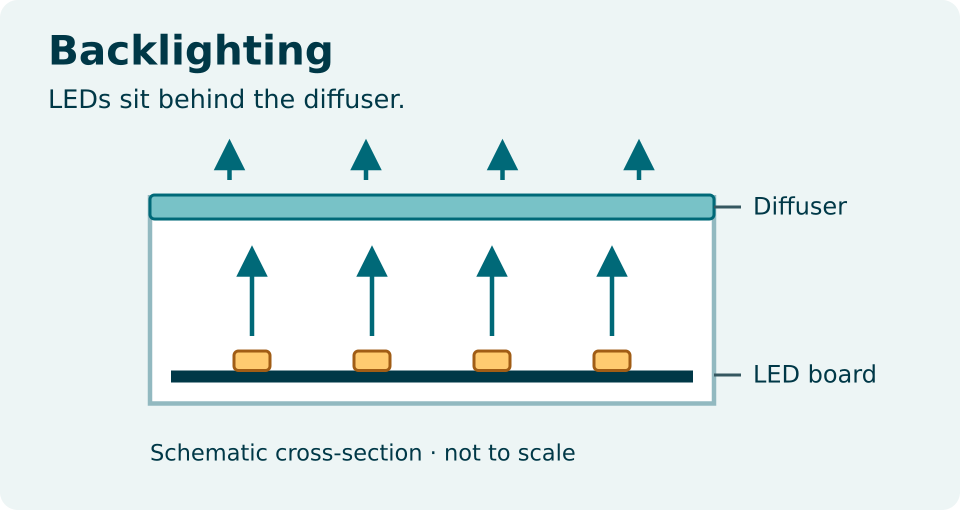
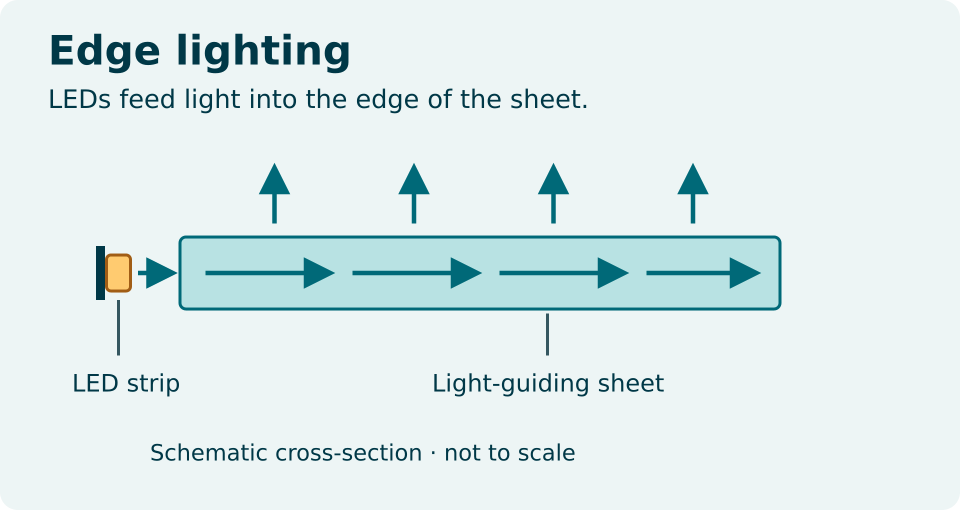
The illumination method plays an important role in selecting the appropriate acrylic sheet. Backlit and edge-lit fixtures use different approaches to distribute light and require materials with different optical properties.
Achieving uniform illumination with backlighting
In backlit fixtures, LEDs are positioned behind the diffuser. The diffuser distributes light across the surface, helping minimize visible hotspots and create more uniform illumination.
ACRYLITE® Satinice optimum light diffusion and ACRYLITE® Satinice optimum light diffusion enhanced feature volumetric diffusion properties that help conceal individual LEDs and distribute light throughout the sheet.
How much diffusion do you need?
The required diffusion depends on the LED configuration and the distance between the LED board and diffuser. Use the table as a starting point for comparing grades in your fixture.
| Fixture design | Diffusion requirement |
|---|---|
| More LEDs, closer LED spacing, more distance between LEDs and diffuser, or lensed LEDs | Less diffusion Start by evaluating 0D010 DF or WD852. |
| Fewer LEDs, wider LED spacing, less distance between LEDs and diffuser, or bare LEDs | More diffusion Start by evaluating WD008 DF or WD855. |
Consider these factors during fixture development to determine the appropriate grade and thickness for the desired illumination.
Distributing light through the sheet with edge lighting
In edge-lit fixtures, LEDs introduce light through the edges of the acrylic sheet. ACRYLITE® LED’s light-guiding properties distribute illumination across the sheet surface. LED strips are typically positioned against the long edge of the sheet.
For wider light guides, select an ACRYLITE® LED light guiding edge lit sheet grade based on the illuminated width and LED layout. The technical brochure (PDF) provides grade recommendations and installation guidance.
For narrower fixtures, ACRYLITE® Satinice crystal surface and ACRYLITE® Satinice velvet texture extruded DP9 may also be suitable. Their frosted surfaces can produce a more pronounced, textured appearance when illuminated. Compare the appearance and brightness in a prototype.
Need help selecting the right diffuser?
Choosing the appropriate diffuser involves balancing several factors, including light transmission, diffusion, appearance, LED configuration and fixture design.
ACRYLITE® offers a range of light-diffusing and light-guiding acrylic solutions to support different lighting requirements.
Contact our technical team for assistance with product selection, material recommendations and your specific lighting application.